Saturday, 22 March 2014

Panama - birding with an expert guide. Part 2

Panama - birding with an expert guide. Part 2.

16 February 2014 - the second day of Avocet Tour's Panama expedition, with Carlos Bethancourt as our guide. This morning was our first opportunity to watch the sun rise. I was so eager for the experience that I crept up the Tower's staircases just after 5 AM. The building was dark. I was too early even for the staff - the fourth floor was pitch dark and the kitchen was empty. No coffee. I like to start my day gently with silence (of which there was plenty), a good book or my journal (I had both clutched in my hands) and a cup of strong, sugary coffee. Clearly I would have to wait for the coffee.

Figure 1. This whiskery cutey is a White-whiskered Puffbird waiting for a lizard or large insect to make itself known so he can snap it up and beat the living bejesus out of it and then swallow it. Semaphore Road, 16 Feb. 2014 Photo by Chris Siddle


About 5:30 the first noise reached my ears. It was a roaring, a drawn out guttural, rageful bellowing. Howler Monkeys! These are fair-sized New World monkeys, the males equipped with enlarged throat sacs and cartilages in their tracheas that resonate and amplify their voices all in the service of marking the troop's territory. "We've got this patch. Stay away!" the males seem to be roaring from the tree tops at other distant noisy troops. One morning I could hear four troops roaring in the national park around the Tower, three to the north and one to the south. Back in the Okanagan I'm pretty sure two of my neighbours who succumbed to boomer-lunacy and bought Harley-Davidsons so big they can barely them hold upright are going for the same audio effect each morning and evening when they rev their engines.

I returned my books to my room on the still silent second floor and climbed all the way back up to the roof. Dawn was diluting the dark. Birds were beginning to stir. This was it!

I am afraid that I have fallen victim to the hype that generally surrounds canopy walkways and towers. I fell for the promos in tropical Queensland and I fell for them in Peru. Now, once again, in Panama I had set my sights too high. It's like I expect dozens of species of exotic jungle birds to flutter around me in blissful ignorance of my existence like several pages of the local field guide come to life. The reality, that of some birds flying by and a few birds feeding in the canopy depending upon which flower is in bloom or which seed or fruit is ready to eat at the moment, always disappoints me a little. However, with several opportunities to view sunrise or sunset, I felt the Canopy Tower over the course of a week came closest to satisfying my elevated dreams.

Each morning and evening a pair of bright green Mealy Parrots would fly by closely together, one individual slightly ahead of the other, obviously more deeply attached to each other than your average pair of birds. I am not a romantic. I don't care a fig whether a pair of birds mates for a lifetime or for three seconds. In fact, one of the most irritating questions non-birders ask me is "X species (swans, eagles, small-vented scaley plodders, etc.) mate for life, don't they?" as if expecting birds to be more capable of long term monogamy than we are. My answer, "Hey, if most humans can't manage to stand each other for a lifetime, why do you think birds can?" never seems to satisfy the person who asked the question in the first place. That said, I have to admit I do have an soft spot for parrots. Long-lived, individualistic, and cranky, when one parrot pairs with another often their mutual bond touches my heart. They stick so closely together. This pair of Mealy Parrots, flying in such proximity that it seemed as if their wings must touch, skimmed over the canopy following the same route as they had yesterday morning and will follow tomorrow morning crying loudly their croaky, squeaky ode to joy.

Figure 2. Fasciated Antshrike, a slow and deliberate forager of the understory. Photo by Chris Siddle. 


By 6:30 other guests were joining me on the roof. The Green Shrike Vireo began his three note chant. A Blue Cotinga was a beautiful surprise. A female Summer Tanager, uniformly yellow-green, appeared briefly but a Golden-headed Tanager, much more elaborate in various colors, stuck around for a while. Other birds included Red-lored Parrots, slightly smaller than Mealys, a Squirrel Cuckoo, a Violet-bellied Hummingbird, White-necked Jacobins from the feeders four floors below, and a Dusky-capped Flycatcher.

We spent the morning walking down Semaphore Hill Road. We progressed until the something interesting - a stream of leaf-cutter ants, the large earthen-looking arboreal nests of the Aztec Ant, the national tree of Panama, a Morpho butterfly-  caught our interest. Life forms were so diverse and so amazingly abundant than we walked only 400 m in four hours!

The forest was is a mix of huge veterans standing among much younger jungle. One could almost hear the plants competing for light. Vines climbed and draped and hung, some so large they matched the thickness of small trees back home. Airplants grew luxuriantly from every possible coign. Some leaves were huge, bigger than umbrellas.

Snuffling in the leaf litter was my first Nine-banded Armadillo. A few metres farther down the shaded green road a mother White-nosed Coati and her baby crossed the narrow pavement. The kitten or cub or whatever a young coati is called was missing half its tail. On the downslope a small troop of White-faced Capuchins moved through the mid-canopy, avoiding our party.

Birds included an Olivaceous Woodcreeper, a Southern Bentbill, two male Slate-colored Grosbeaks, a Black-crowned Antshrike, a Ruddy-tailed Flycatcher, a Blue-crowned Manakin, Dusky Antbirds, a Spotted Antbird, a pair of Dot-winged Antbirds, a Broad-billed Motmot, White-flanked Antbirds, a squat and stolid little White-whiskered Puffbird, a loudly singing Black-bellied Wren, and a Gartered Trogon. It was Tropical Birding 101, the introductory course, with a wide and diverse selection of birds that previously we have seen only in field guides or possibly not at all.

Our afternoon was equally amazing but with an emphasis on wetlands. Carlos took us to the famous (in Panama birding circles) Ammo Ponds, which is to say that we stood on a paved road crossed by a closed sliding chain-link gate controlled by a man in a uniform inhabiting a guardhouse. He ignored us and we were too busy looking at the birds to pay much attention to him. Occasionally an official looking pickup truck pulled up, he opened the gate to let it in, but always the gate closed soon after.

There was one pond to our left with a 20 metre buffer of thickets and trees between us and the water. To our right was a fringe of jungle and ahead to our right was a second pond, but overgrowing with thicket grasses and brush. We could see only one end of it by peering around the corner of the gate. This small, fenced in spot may seem like a poor excuse for a birding spot, but it wasn't. As in the morning, we were once again busy keeping track of the birds we saw: Red-crowned Woodpecker, like a small Red-bellied Woodpecker, obvious a member of the large Melanerpes genus. Panama doesn't have many woodpeckers. As far as I could see in our limited travels, the Red-crown was the most frequently encountered.

Figure 3. Rufescent Tiger-Heron. A juvenile at Ammo Ponds 16 Feb. 2014. Photo by Chris Siddle. 


As with any damp and semi-open spot flycatchers crowded in: Boat-billed, Social, Piratic, Streaked, and Dusky-capped flycatchers, as well as flycatchers called by other names such as the ubiquitous Tropical Kingbird and Great Kiskadee. The tyrant flycatchers are the largest family of birds in the New World and the largest family in Panama with at least 93 species present. Many are named for the colors: white, gold, sulphur, yellow, yellow-green, greenish, ochre, ochraceous, sepia, rufous, vermilion, olive, olivaceous, yellow-olive, bronze-olive, tawny, ruddy, rufous, rusty, brown, brownish, gray, slaty, sooty, dusky, black, and my favourite, the ever-so-specific 'bran-colored".  Many have 'flycatcher' as a common sort of surname, but others are named for their vocalizations like pewees, phoebes, and kiskadees. Several are named for the family's tendency to be bossy: tyrants, kingbirds, attila, and piratic flycatcher, while some are bossy but small: tyrannulets, and another favourite, pygmy-tyrants. Pygmy-tyrant! In a mere two words a character has been created. Some seem to have been named for accidental injuries: flatbill, bentbill and twistwing, but, of course, there are morphological and behavioral reasons for these names. Sometimes, and I love this, the species' name seems to reflect the taxonomist's exhaustion at dealing with so many drab little flycatchers. Take the Mouse-colored Tyrannulet. What colour is mouse-color, pray tell? Or how about the peevishness reflected in naming a bird the Paltry Tyrannulet?

Figure 4 - Green Honeycreepers, commonly seen from the top of the Canopy Tower. Photo by Chris Siddle. 


Variable and Yellow-bellied seedeaters flew to the marshy edge, while an adult Green Heron perched quite still above the water. Orange-chinned Parakeets rocketed overhead. We were to get good looks at the parakeets a few days later. A pair of Mangrove Swallows were investigating and open pipe on the gate as a possible nest site and a newly fledged Black-throated Mango juvenile was visited by a female. I overheard a couple of British birders discussing a "ruddy huge bittern" so I wasn't completely surprised when I spotted a pale juvenile Rufescent Tiger-Heron not long out of the nest. It still had a few downy feathers clinging to it. In the marsh edges were a Greater Ani and several Smooth-billed Anis, as well as Great-tailed Grackles and a Northern Waterthrush.

Rod Wark spotted a large mammal walking into openest part of the overgrown pond. This turned out to be a Lesser Capybara, likely the second largest rodent in the world (the Greater Capybara beating it by some pounds). It looked like a square-headed light brown beaver atop four long legs. It had a short mud bath then disappeared into the brush.

On the roadway and its edges were a few Buff-throated Saltators, Clay-colored Thrushes, Ruddy Ground-Doves and a White-tipped Dove, the same sad-voiced little pigeon common along the Lower Rio Grande in Texas.

Overhead were the ever Black and Turkey Vultures, and Gray-breasted Martins as well as a few Short-tailed Swifts and two Ospreys. Jen spotted a very large multi-colored squirrel - a Variegated Squirrel.

Before we left we added Crimson-backed Tanagers, Blue-gray Tanagers, Yellow-rumped Caciques, Rufous-tailed Hummingbirds, Baltimore Oriole, Tennessee Warblers, Red-legged Honeycreepers, a Common Tody-Flycatcher, two Golden-fronted Greenlets, two Blue Dacnis, a Mourning Warbler, and a Yellow-crowned Euphonia to the list.

Two of the final birds of our second day in Panama were a Ringed Kingfisher, the first of several we were to see, rattling over us at the foot of Semaphore Road and a Great Tinamou crying its weird, slightly Common Loon like quavering whistle from the forest surrounding the Canopy Tower at dusk.

Note - in my discussion of flycatcher names I omitted "elaenia" as one of the common "surnames'. The elaenias are common and widespread in the Neotropics and deserve mention but for the life of me I was unable to find out the derivation of the word "elaenia". Can anyone help me?


If you wish to comment on this post please do so via my email: chris.siddle@gmail.com


Wednesday, 12 March 2014

Panama - birding with an expert guide. Part One.

Panama - birding with an expert guide. Part One.

30 December 2013 - The forest was silent and full of snow. No movements, neither wind nor birds, disturbed the winter scene. I sighed and silently repeated the well known line from Richard III, "now is the winter of our discontent..." as so many other Canadians had done this season. Most people were unhappy with the unusually cold and severe weather that had plagued the nation, at least those parts east of the Rockies all the way to the last rock east of Newfoundland. To borrow from Shakespeare again, the winter winds had blown and cracked their cheeks, keeping at least nine of the ten provinces huddled beneath winter's frigid blasts, and even B.C. unseasonably cool for months.

Fig. 1 - The Red-mantled Howler Monkey, the species responsible for the impressive roaring that rose from the forest 30 mins. before dawn each morning. We spotted this male along Pipeline Road near the Rainforest Discovery Centre. Photo by Chris Siddle. 


As usual the Okanagan Valley had escaped real Canadian winter, whether its residents realized it or not. Oh, sure, there was the usual whining and whinging about how cold it was in Vernon, but, really, -20 or -25 C for a few days is nothing to complain about. But still I was unhappy, not because of any misconception that the winter was any harsher here than usual but because of one simple fact - the woods were almost empty of birds. Go for an hour's walk through the Douglas-firs and Ponderosa Pines and you would be hard pressed to find a flock of chickadees. Even Red-breasted Nuthatches which last winter were everywhere were hard to find. On a good day this winter one might turn up a couple of Golden-crowned Kinglets, maybe a Pacific Wren but there were few or no Pine Grosbeaks in the lowlands, no siskins, precious few goldfinches, only a scattering or individual Red Crossbills. The list of absent and missing went on and on.

And here I was deep in the woods along Highway 33 helping friends Mike Force, Tanya Seebacher, and Ann Gordon with the Big White Christmas Count. By the end of the day we could have written our complete day's list on a post-it note, and the day's best sighting was not of a bird, but of a Short-tailed Weasel which apparantly had taken up residence in a snow-covered pile of discarded Mule Deer bones. Happy is the weasel that can gnaw away all the winter long.

At the post-count gathering in a dingy pub in Rutland, the four parties compared their results. As usual Doug Brown had come through with the better birds, for he is willing to take on the longest and toughest routes, but even with Doug's list the count failed to stir any positive feelings within me. I was gloomily regarded the dregs in my cup of hot chocolate when Chris Charlesworth who runs AVOCET TOURS out of Kelowna said that he had to wait only six weeks before he was off to Panama.

Fig. 2 - Panama's Canopy Tower. Single rooms are on the second floor. Double-rooms are on the third. The fourth floor is the lounge, commons and dining area. Stairs led from the third floor to the tower's deck, around the big white soccer ball. Photo by Chris Siddle. 


"How many people have signed up?" I asked.

"Only four, but that's enough to cover my immediate costs. I'm really looking forward to those colourful Panamanian birds and some nice hot weather. I hate the cold."

Then I heard myself say, "Hey, would two more be a problem on the trip? I think I can talk Sonja into going."

This was a sudden high hope borne of desperation, but with only the minimum of whining, I was stunned when Sonja agreed that I should join the tour but that she wasn't interested in what she knew would be a hard core birding holiday. She checked Panama online but could find little that would offer her entertainment while I was stalking the rainforest paths. However, if I could find the money, I was free to go.

My copy of A Guide to the Birds of Panama by Robert Ridgely was a revised first edition from 1981. I could do better so I ordered Angehr and Dean's The Birds of Panama (2010) as well as Angehr, Engleman and Engleman's A Bird-Finding Guide to Panama (2008). I already had a subscription to the wonderful online resource, HBW Alive so I  spent the next few weeks printing colour plates of Panamanian birds based upon the plates from The Handbook of Birds of the World (16 volumes). All one has to do with HBW Alive is look up a bird family, apply the geographical filter, in this case Panama, and at the press of a computer key a plate of species is produced, with or without common and scientific names. It's a convenient way to learn one's birds before the trip, though I think flash cards made by cutting up an extra copies of a foreign field guide ultimately work better for me. (I can hear the shocked intake of breath. Cut up a book? Cut up a field guide! Yes, darling, they do print more than one copy of the book. Ever visited a book warehouse? Ever shopped in a bookstore that sells remainders?)

On 14 February, 2014, Chris Charlesworth, Candice Eikermann, Rod Wark and I met at the Kelowna Airport for the first of the flight that would land us in Panama City the next morning at 8 AM. Shirley Coffin of Trail joined us in Seattle and we picked up the last three members of the tour at a hotel near Panama's Tocumen Airport, Margaret Bryan of Kelowna, and Karl Brunner and Jen Dusting of North Vancouver. Candice, Rod, Margaret and I were old hands with Chris's tours, while Shirley, Karl and Jen were new clients. Karl and Jen were new to the world of birds and birding. Boy, were they in for some surprises!

Chris Charlesworth had put two years of planning into this trip and it showed. He had booked our accomodations with the famous Canopy Tower company, who picked us up at the airport and looked after us for our entire stay. No details were too small for the staff. We had excellent food, good rooms, good transportation and a world-class bird guide as well as several other bird and nature guides at our disposal every day.

The Canopy Tower has been covered so frequently in the media that I won't go into detail about it here. If you're interested, check out the company's website which includes a profile of the company's president, Raul Arias de Para, a gracious man who ate several meals with us at the Lodge. After his purchase and conversion of the United States radio/radar tower in Soberania National Park into a hotel in 1995, he built the Canopy Lodge near El Valle in the highlands west of the canal. We stayed in the Canopy Tower for 7 nights and the Canopy Lodge for 4 nights. The only disadvantage to such first-class treatment where a highly efficient staff looked after us is having to return to everyday life at the end of the vacation. (And, of course, having to navigate the petty officious complexities of grubby airports makes one's return to everyday life just that extra bit nasty.)

When we arrived at the Tower we met out bird guide Carlos Bethancourt. Carlos is Panamanian and proud of his country. He's also very personable. Over the next 12 days he was to prove to be the consummate professional. I have never seen anyone as able to spot birds, often very small green or brown birds, in the dense understory or high in the canopy of the forest and get a  scope trained on them as quickly as Carlos does. And I swear he is a bit of a magician for once a bird was visible in the scope, it usually stayed still long enough for 7 other people to see it. I have done my share of guiding and I have carried a scope since 1976 but in the three days that I attempted to find tropical species alongside Carlos I was an absolute failure. I was still adjusting tripod legs and hadn't even tried to find the bird in the scope yet by the time Carlos was set up and showing people the Purple-legged Scalp-tingler or whatever. From Day 4 onwards, unless we were scheduled to go near a pond or to the coast, I left my scope in my room and trusted Carlos would find the birds far faster than I could. However, I did notice that Chris Charlesworth was rapidly learning Carlos's techniques and by the middle of the tour we could count on at least two scopes on the bird. In addition, other guides from the Canopy company, like the excellent Moyo or Cesar, the raptorphile, were often along to provide an additional scope and excellent identification advice.

The great thing about the tower, aside from the good food and excellent service, is its flat roof-deck poking up in the middle of an otherwise unbroken forest canopy atop Semaphore Hill in Soberania National Park. At the very least one one can witness the fast dawn of the tropics, see the distant city of Panama and the Canal and hear the deep roaring of Red-mantled Howler Monkeys, the frog-like croaks of Keel-billed Toucans, the screechings of Mealy  and Red-naped parrots, the vireo-like song of the Lesser Greenlet, and the three clear whistles of the devilishly hard to spot Green Shrike-Vireo. Some of the easier to spot birds might include the Plain-colored Tanager, Green Honeycreeper, and a wintering Bay-breasted Warbler or two. A pretty and loud song might be coming from a Palm Tanager, three of which liked to forage around the railings of the deck. As the day warms Black and Turkey vultures pass overhead, a local Short-tailed Hawk often hidden among them. It always pays to check vulture kettles: on our first day I spotted an adult King Vulture among them and the next day at noon figured out that the very large raptor high above, showing only traces of light color in its wingpits, was an immature King.

For the next two hours every dry morning it's one surprise after another, depending, I suppose, upon the season and which trees are flowering or bearing ripe fruit near the Tower. Mammals that we spotted in the canopy during our seven day stay included a Northern Tamandua, a Brown-throated Three-toed Sloth, a Variegated Squirrel, and Geoffrey's Tamarins, bare-faced little primates with naked dark faces and extravagant chestnut mullets.

The staff at the Tower feed hummingbirds with a series a feeders near the main entrance on the first floor. While we were there the most common hummingbird was the large White-necked Jacobin. We got used to seeing the purple-headed males flashing the large white tail patches at each other while they competed for places at the feeder. Since most Panamanian hummers are predominately green, I greedily tried to turn the green female jacobin into a new species for my checklist, but more knowledgeable birders prevailed and corrected my misidentification.

A single Long-tailed Hermit appeared at the feeders once every 30 minutes or so. This hermit is the Long-billed Curlew of its tribe with a long thin impressively curved bill as well as long white central tail feathers. What a beauty.

Fig. 3 - Most tanagers are colourful but not the well named Plain-colored Tanager, common around the Tower. Photo by Chris Siddle


I was lucky enough to be one of few guests to glimpse a White-vented Plumeleteer, a medium-green hummer with a black tail and white undertail coverts.

After a day to recuperate from our all night flight from Las Vegas to Panama, we were ready for Carlos Bethancourt to lead us on our first full day of birding in the field.

To be continued.

Send comments to chris.siddle@gmail.com

Monday, 10 March 2014

Our Hunt for the Daffy Duck

This is the story of a twitch and the lessons that emerged from it.  Most of you know what a twitch is but for those who think it means an involuntary muscular movement usually of the face, please know that a twitch in the birding world is a fast trip to see a rare bird. The bird is usually one that is out of its usual range, a stray, a "vagrant" as we call it, and though some rare strays adapt to their new homes and stay put for long periods of time, most vagrants occur at the location of discovery only a day or two and then disappear for places unknown. Thus speed is of the essence. That's why the decision to make a twitch must be done quickly and why the trip almost always has a rushed feeling.

OK, it's not a Baikal Teal. It's a male Cinnamon Teal near Vernon in June, just beginning to lose his spring finery as he starts his molt into female-like eclipse plumage. 


My friend Chris texted me Saturday morning, 8 March just as I was starting my exercises in the basement of my Vernon home. "I'm feeling twitchy" he texted, and since I had checked the B.C. Rare Bird Alert the night before I knew he was referring to a Baikal Teal that Russ Cannings had spotted near Nanaimo Friday. I shared the text with my wife Sonja who immediately pointed out that it was March, a relatively quiet time for birds in the Okanagan and that I didn't seem to have anything important on for the weekend, so why didn't I go for it. "You'll travel thousands of miles for a Colima Warbler. What's 1000 km for a Baikal Teal?"

Indeed, why not? I texted Chris that I would pick him up at his apartment in Kelowna in about an hour and fifteen minutes, which I did. And sharing the driving of my wife's trusty 2000 Subaru we braved the Coquihalla Connector which was nice and dry and then Highway 5 where the rain began, as usual, where the toll booths used to be. As we descended into the Fraser Valley, the rain moved through a sleety state of steadiness, through heavy to a monsoon deluge and for the next three and half hours the wipers were slapping away on high while we hydro-planed down Highway 1 to Horseshoe Bay where we were lucky enough to squeeze onto the 5 PM ferry to Nanaimo.

Once snug in our hotel room, Chris phoned Russ who arranged to meet us the next morning at a coffee shop not far from the fields where he had spotted the teal Friday and early Saturday morning. The good news was that the rain was forecast to stop overnight.

Sunday was time change day. This event threatened to rob Russ of an hour of the sleep that young men find so sweet, so he postponed our meeting. No problem: we followed the instructions on the B.C. Rare Bird Alert to the farm lane which led to the field where the Baikal had been feeding with North American Green-winged Teals. A large yellow front-end loader blocked the lane. Propped against the machine was a piece of cardboard requesting people to stay out because the farmers' cows were calving. As Chris and I regarded the sign two shotgun blasts originating from the very field we sought ripped the early morning peace asunder. Interesting cows, I thought, that can be lulled into giving birth by surprise gunshots but abort upon the sight of a scope-lugging Tilly-hatted birder. Curious country ways.

So no guide, no access, and waterfowl taking fire from unseen sportsmen. We consulted our B.C. Rare Bird notes again and walked  rocky path down to a lookout overlooking the Nanaimo estuary from the side of Highway 19. In the next hour we were joined by about 25 other birders, most of them on a Brant festival trip from Victoria who had stopped by as the news of the errant teal spread so that even 70 year olds without computers were hearing of its occurrence. Russ appeared and addressed many of us, telling us the story of the teal. Then as gently and diplomatically as possible Russ dropped the H Bomb.

H stands for hybrid, and a hybrid is the very bad news indeed for a lister. A hybrid may be the product of the mating of two attractive and fascinating fowl, but it counts for naught, because it isn't pure one thing or the other. Hybrids are freaks, unvalued violations of our unwritten code that species should stick to their own kind. Say a Spotted Towhee produced a nice healthy offspring with a Dark-eyed Junco. The resulting bird may be pretty and fill your yard with unique warbles and pretty trills and the mating might be of interest to a scientist, but what does a lister do with the bird? There's no place on his list for it.

Russ explained how he was scoping the original Green-winged Teal flock back on Friday when BAM there it was, a Baikal Teal drake in breeding plumage. Being one of the younger generation inseparable from his cell phone, he phoned his father, ornithologist, Richard Cannings, who opened a field guide and described to son Russ what the field marks were. Son, unfortunately, focused on the duck's body, more than its head, and so for a little while it seemed to be a "good bird" though the length of the bird's tail bothered Russ. Later when someone produced a photograph of the bird taken from a distance, people, including Russ began to worry about the bird's face. The facial pattern just didn't look right, not the long narrow white slightly flattened circle bordering the bird's face, surrounding a big green crescent behind the eye, and two tan commas facing each other and separated by a thin black line below the eye.

Chris and I saw one photo of the bird. The bird looked too big, its neck too long, and the facial pattern all wrong. Although we tried scanning from Duke Point at a second location that morning, we didn't find the bird. Eventually we had to start for home. The duck was seen Sunday, late in the afternoon, but by then we were driving through Hope.

It's interesting and perhaps understandable that the first birders who responded to Russ's immediate phone calls to the birding community didn't question the bird's identity. Several of these heavy hitters unthinkingly accepted the bird as a Baikal Teal, high-fived each other and moved on. It is to Russ's credit that he and a few others looked critically at the meagre photographic evidence available on Friday and Saturday and started to worn birders that the possibility that this birds was a hybrid existed.
For Chris and I however the warning came too late, but that's a risk twitchers face.

As a retired teacher, I ask what can birders learn from the Baikal Teal episode. Well, carry a field guide that shows the vagrants that have reached our shores. By chance a new guide has just been published, The Rare Birds of North American. It would fit in the car nicely.

Secondly, study field guides like The Rare Birds of North America. Be prepared. Learn which vagrants are most likely to occur in your area. Do you know, for example, that there are multiple records of Brambling, a Eurasian finch, in British Columbia in winter and that your chances are much higher of encountering a Brambling than say a Lucy's Warbler, which is a native North American but lives in the deserts of the American Southwest. Another stray you could reasonably expect is the Little Bunting, much, much more rare than the Brambling, but also easier to overlook. It would be awfully easy to misidentify a Little Bunting as some kind of native sparrow unless you had studied the bird's plumages ahead of time. Studying foreign field guides for places like northeast Asia prepares the birder for the unexpected.

Thirdly, if you do encounter a bird that may be a rarity, get as many photos of its from as many angles as you can, and take field notes to record the things that may be subject to the vagaries of light and shadow. Note behavior, colour, pattern, vocalizations, as well as external factors like time of day, foraging habitat, and weather.

Fourthly, make as few assumptions as possible. And most importantly don't assume because most of the birds in a flock are American Green-winged Teal, for example, that all the birds in the flock are Green-winged Teal. Look at every single bird possible. Here's where studying plumages ahead of time pays off. The more you know, the faster the bird that is different will stand out.

Fifthly, if you strongly suspect that you have a bona fide rarity, get on the phone fast to alert other birders so that they can see it too. However, if you aren't sure about the identity of a bird may be bring in just a buddy or two to have a critical look before you alert the nation. This is much easier said than done, of course, and I do not mean to suggest a criticism of Russ Cannings in this paragraph.

I am writing this on Monday, 10 March, 2014. For all I know further photographs will reveal that the Nanaimo Baikal Teal is the real deal, perhaps wearing some obscure, seldom shown immature first winter male plumage and everyone who saw it will be satisfied. There could be a happy ending for some of the twitchers. However either way, whether the duck is pure Baikal or a daffy looking mix of Baikal and some other duck, my points about being prepared will still stand and if practiced will make you a better birder.


b

Monday, 9 December 2013

Red-tailed Hawks in B.C.'s Southern Interior.

Red-tailed Hawks in B.C.'s Interior

1. What constitutes usual versus unusual plumage? 

Figure 1 - RTHA - light morph white-chested adult with medium belly band. Photo taken in Nov. 2013, courtesy of Rick Howie.

Things to consider when describing a Red-tailed Hawk:
1. colour of chest
2. colour of chin
3. extent and darkness of the belly band
4. colour of upperparts
5. presence and extent of pale scapular patch
6. eye colour
7. background colour of uppersurface of the tail
8. presence or absence of a broad band on the trailing edge of the wing.
9. presence of patagial mark

 I would consider the Red-tailed Hawk in Figure 1 to be quite typical for many Red-tails in the southern interior of B.C. A variation on this basic light morph-light chest theme is shown in Figure 2. 

Figure 2 Adult light morph Red-tailed Hawk, Kamloops area. Buffy chested with medium belly band. Photo courtesy of Rick Howie.

Most of our local adult Red-tails have tawny or white breasts. However adults with brick-red breasts, dull brown breasts, and brown and white streaked breasts do occur.

The majority of our light morph adults show belly bands made up of dark feathers lined vertically across the birds' lower undersides. Across the spectrum of red-tail types belly bands can range absent to completely black. Brian Wheeler, famed raptor expert, writes that a belly band is characteristic of the Western Red-tailed Hawk, Buteo jamaicensis calurus.

Here are three examples of fairly typical western type Red-tails with different belly bands:

Three RTHAs photographed northwest of Swan Lake, N. Okanagan, 4 Dec 2013 by CS. 


Now for a very unusual plumage seen recently in the Kamloops area.

Check out the bird in Figure 3. This bird looks much like an eastern Red-tailed Hawk, Buteo jamaicensis borealis, but was photographed in November 2013 in the Kamloops area by Rick Howie.
Notice the single subterminal tail band, the white throat (as opposed to the bird in Figure 2), and the delicate belly band. What a stunner!

Figure 3 - Rick's eastern type RTHA, Kamloops area, Nov. 2013

Figure 4 also shows this same bird.

Figure 4 - Rick's eastern type RTHA- another view


Contrast this bird with the hawk in Figure 1. With the kind of variation by our Red-tails, it's little wonder that beginning birders have trouble identifying hawks. 


2. More images to ponder: what follows is a gallery of Red-tailed Hawks photographed locally. Consider the effects that age, morph or "colour phase" molt and fading play in producing the huge variety of Red-tailed Hawk plumages we see in our study area.

Figure 5 - A dark morph adult RTHA at Westwold, 21 Nov. 2013. Photo by Chris Siddle
Figure 6 - a black RTHA, possibly a Harlan's Hawk. Douglas Lake, 21 Nov. 2013.

Figure 7 - This RTHA lived around the base of Silver Star Mountain during the spring and summer of 2013. It appeared to be an intermediate morph with a very poorly defined belly band. However, it was the apparent general faded aspect of this individual that set it apart. It was paired with a "normal" light morph adult. Mid August 2013. Ph - C S.


Figure 9 - A RTHA adult, judging by the broad band on the trailing edge of the wings, in molty plumage, especially the tail. Vernon, August, 2013. Ph - CS.  


Figure 8 - Note the poorly developed, narrow band along the trailing edge of the wing. This is characteristic of an immature as are the light eyes. An adult shows a dark broad trailing edge as in Figure 5. Okanagan Landing, 11 Nov. 2013. Photo by Chris Siddle.


Any comments? Please email your comments to chris.siddle@gmail.com.


Saturday, 23 November 2013

Fall Birding on St. Paul Island - Part Four.


Fall Birding on St. Paul Island - Part Four. 

The story so far: I was a participant in an ABA tour of St. Paul Island in the Pribilof Islands from 18-26 September, 2012. Part Four concludes my account of the tour.

21 September 2013, continued.

We were introduced to the Crab Pots which sounded like a great name for a local bar band, but were actually crab traps made of metal framing, wire and rope. The traps were stacked high like very tall book cases in semi-orderly rows on flat ground close to the Salt Lagoon near town. The grass grew long around the main stacks and today, under the direction of Maestro Gavin Bieber, Mark Faries and Chris Hitt volunteered to walk up and down the rows to flush out birds while the rest of us waited around the outside like eager bird dogs. This afternoon produced familiarity with the routine but no birds.

The crab traps.


Gavin took us to the Antone Putchkie Patch where our chorus line repeatedly flushed a terrified late Yellow Warbler into hiding in the sedges at Mark’s feet.
 
Dance fever abated, we returned to the Grey-streaked Flycatcher rock pit on Polovina where the flycatcher didn’t appear. Full marks to the guides for persistence of effort though.

And our last stop of the evening (we thought) was Tim’s Pond where Doug, Chris Hitt, and Corrine had a walking race around its margin and flushed another Common Snipe, four Sharp-tailed Sandpipers and a couple of Green-winged Teals.

Back at the New King Eider we were taking off our togs and beginning to settle for a short session of socializing before sleep when Scott appeared like a drill sergeant on a mission to surprise raw recruits, stomping down the hotel hallway yelling, “Everybody up. Everybody out. Rosefinch! Rosefinch! Really rare! Rosefinch! Get on the bus!”

And that’s how we ended up marching in lines across rolling terrain east of town. We hiked up and down old stabilized sand dunes covered with short tundra-like vegetation which made the area resemble a golf course. We saw the sun go down and night rise from the Bering Sea, with a breeze bringing the the barking of fur seals intermittently to our cold ears. We scrutinized everything that flew or hopped in front of us down hill and dale and back up. During the New King Eider Hotel roust, some of us had managed to put on appropriate clothing, some of us had managed to grab only a sweater, Mark had only flipflops on his feet, Doreene had wet hair from her interrupted shower… but we were all smiling at the chance of finding a small songbird that Doug and Scott had glimpsed an hour earlier, a small Asian songbird… and even though we didn’t find the bird, you know it was a fine way to end a day in which we had already seen a very special eagle.

It was not unusual to spot a pair of Orcas off any of the fur seal beaches. 


22 September 2013 

The pace and scope of discovery was slowing, of course, as we had seen the puffins, the fulmars, the shearwaters and other seabirds, the eagle, an Asian stray, and a couple of Alaskan specialties already. Now was the time to slow down and get a better sense of the island. At least that was how some of us felt. The guides seemed locked into their rarity search methodology and a few of the hard core listers stifled their impatience waiting for the guides’ strategy to pay off as it had with the discovery of Middendorff’s Grasshopper Warbler and other strays so far this late summer and autumn.  I don’t want to create opposing camps where none existed. Let’s be honest. I think everyone was a lister. However, for some who had never been to one or more of the Alaskan islands before each day had new meaning, new sights, new sounds, and between rare birds we needed time to take in the novelty of just being on St. Paul Island. Today we had a near perfect day for it – calm mostly, with sunny periods and high thin smears of cloud. No rain fell until just before dark.

We started at East Landing where an adult Thayer’s Gull standing on the boat launch was new to our island list. The Salt Lagoon near town held Rock Sandpipers, Ruddy Turnstones and some Western Sandpipers, also new to the list. A Peregrine over the cliffs toward the Reef Rookery was only our second of the tour.  From the Crab Pots twenty Rosy Finches peered at us from around the traps and a small flock of Hoary Redpolls was flushed out. On the nearby Salt Lagoon a fair bit of excitement prevailed among the birders, especially those who had never neen to any of the islands of  Alaska before when two tattlers appeared along the very minimal shore. Gavin went to work, not truly happy to have to opt out of Scott and Doug’s efforts to find Asian passerines. After telling us that the only good way to distinguish Gray-tailed Tattlers from your basic prosaic Wandering Tattler was by voice Gavin hiked across some shore to flush the first tattler toward us. As it vocalized softly, Gavin identified it as a Gray-tailed, my first for North America. A second Gray-tail appeared nearby.

By mid-morning conditions were deemed right to resume the search for the Rosefinch. We lined out as instructed and walked across the tundra. A few minutes into our tromp we were ordered to stop. About 70 metres in front of us, perched on a tall stalk was our bird, a female Common Rosefinch, looking much like a House Finch (it belongs to the same genus) without the streaks on the underparts. OK, visually nowhere near the same class of exciting life bird as the White-tailed Eagle.

After lunch we finally re-located the Pavolina Grey-streaked Flycatcher and I was able finally to get a good look at it through a scope. Thanks, Gavin, Scott and Doug, for your repeated efforts to pin down this active, shy little bird.

We started toward Northeast Point when a message came through to Gavin that Scott had briefly encountered an unidentified finch in the big pit on Pavolina Hill and needed help to re-locate it. So back to Pavolina we returned and while waiting for Doug to scout the slopes above the pit we were treated to another sighting of the White-tailed Eagle, this one prolonged and highly satisfying. The eagle soared in circles low over us in brilliant sunlight for a couple of minutes. Wow!

Scott’s mystery finch never showed, so after watching Doug thoroughly search the slope above us, we clambered back into the bus and drove once again toward Northeast Point.

The routine was always the same at Northeast Point. Check Hutchinson’s Hill and its notch above the seal colony, silently and individually pay our respects to the U.S. Navy sailor, James Heath, Gunner’s Mate, First Class, who lay in his lonely grave so far from home, walk back toward the bus, line out according to Gavin or Scott’s instructions and walk through the big putchkie patches on either side of the road, check Webster’s Beach and the little bay, climb the little hill to Webster House, and either walk around Webster Lake or hang out at Webster House watching the buntings, longspur and rosy finches forage around the pile of wooden pallets.


On the way back to town I glanced east over the ocean between St. Paul and a small island and simultaneously two Orcas broke the surface with their tall dorsal fins, a fitting end to the afternoon.

Three other birders were on St. Paul at the same time that we were. They were Paul Sykes, Larry Peavler, and a young fellow who was identified to me as Tennessee Mike. They drove around in a little white Japanese import that according to Larry was corroding so fast in St. Paul’s salty sea air that the rust could be seen devouring the car’s panels. Paul is a well known birder and birding guide, a retired biologist who once worked to conserve Snail Kite among other species.  His ABA life list is one of the longest known to exist. He has visited the islands of Alaska in spring and fall dozens of times as has his buddy, Larry Peavler who also had an enormous list. Tennessee Mike was a fair bit younger than Paul and Larry but somehow I didn’t even catch Mike’s last name.
   
Paul, Larry and Mike had seen an Eye-browed Thrush, an American Robin-like bird that’s paler, slimmer, and most importantly not North American. It’s a casual northeast Asian migrant through the Pribilofs, and a desireable addition to anyone’s list. They had seen the bird in St. Paul’s quarry, a location that we were soon to grow familiar with but never used to.

The thing about the St. Paul quarry is that it looks so other worldish that it resembles a movie location for an episode of, say, Lord of the Rings. Its boulders and the dark spaces between seem the home of spirits aware that strangers were trespassing.

“Good place for an ambush,” Doug said as he stood atop a pale boulder on one side of the narrow canyon and peered down at us looking up at him from the stony path that wound its way through the quarry.  Gavin had us walking quietly up a sort of mini-Valley of the Shadow, part of the quarry that hadn’t been used for years. After digging out and piling up boulders 10 to 20 feet high on either side, the quarry workers had left the place to Mother Nature who had tried to heal the scars with moss, and other low growing plants, giving the place an air of frozen tumult and mystery. The place was spooky, with moss growing over the rocks concealing gaps into which a hiker might easily slip his foot and break an ankle.

“Do NOT climb on the rocks. I DO NOT want anyone hurt!’ Gavin was speaking to us as if we were a pack of attention-deficit six year olds, an entirely appropriate tone to use with listers. A little blue Arctic Fox spied upon us from the ridge to the right. Likely in its short, hard life it had never seen such a large group of humans invade its territory, and in that opportunistic way of scavengers the fox needed to know if we were leaving anything edible behind. Gray-crowned Rosy Finches watching us from the tops of the rocks and suddenly burst into short flights ahead of us. Among them were individual Snow Buntings and Lapland Longspurs. Halfway up the defile the Eyebrowed Thrush materialized out of nowhere, flew around some boulders and perched very briefly, only long enough for two birders besides Gavin to see it.

When some birders in a tour see a bird while others miss it, the tone can turn ugly. Lifer-inequality becomes the source of trouble, with a capital T.  There can be tension, murmurings, discontent, even among our well behaved group. After losing the thrush in the boulders, we still hoped that we could re-locate it. Doug, our permanent flanker, found the bird again but up high almost on the ridge. Certainly WE couldn’t see it though we could see Doug looking at something, something WE wanted to look at too. The damned bird wouldn’t allow itself to be herded into view, and eventually it shook Doug off its trail. We came back to the haunted quarry on twice on 23 September, and again on 24 September and 25 September but never re-located the thrush.

At Southwest Point  a huge Steller’s Sea Lion had come ashore, though mostly it was hidden behind a reef. Even so, his big square head made him easy to differentiate from the pointed-faced fur seals.

Steller's Sea Lion - named for the German naturalist who accompanied the Russians during their voyage of discovery of the Pribilofs. 


After lunch we switched the bus for two vans and proceeded to Northwest Point and Marunich, the former site of a Walrus colony. Here we hiked along the top of a short cliff backing a narrow boulder beach. Offshore a raft of 60 King Eiders swam closely packed. Other birds included a Yellow-billed Loon way out and very hard to see, a Red-necked Grebe, a White-winged Scoter, and a Wandering Tattler which flew down the beach calling loudly. Watching us were Harbour Seals bobbing just beyond the surf. Among the Glaucous-winged Gulls was what I identified as a first-year American Herring Gull. A Red-throated Pipit flew up in front of the guides but I missed it.

After supper our destination was Northeast Point as usual. The routine, described elsewhere, was wonderfully shattered when a tiny bird leapt up from the putchkie in front of our chorus line and after a few metres of fluttery flight dove back into the vegetation. Someone – Scott maybe – uttered the sweetest words I had heard for days, “Old World warbler! Let’s get on it!”

Old World warbler in a putchkie patch. Electrifying reality, especially since I had NO Old World warblers of any species on my ABA list.

The situation was complicated by a couple of factors. First and most basic was that I was standing on the road with four others birders who, like me, had been … well … rather slow to join either of the lines of putchkie marchers. In fact, we had stayed on the road and since the road was a good metre lower than the vicinity of the warbler we delinquents were in danger of being punished for our reluctance to join the chorus lines in the first place. The warbler was not visible from our location. Second, even when Scott and Doug somehow got us to shut up and move VERY SLOWLY into a place where we had a chance of seeing the warbler, whatever it was, there were no landmarks which is pretty typical of a good, thick putchkie patch. No saplings, no mini snags, not even distinct tussocks of grass broke up the monotonous mess of knee high vegetation. In the middle of a good stand of putchkie there’s nothing but putchkie and sedges. Most putchkies are shaped pretty much like all their brothers and sisters. You can try saying something like, “See that really tall putchkie? OK, about 4 metres to the right there’s a small spider web. Two metres in front of that there’s a putchkie that looks a bit like a Christmas tree. The bird is in THAT PUTCHKIE, but you can’t see him right now.”

QUESTION: How long is a metre?

QUESTION: Do you mean the tallest putchkie, or just one of the tall ones?

QUESTION: You said a little spider web. Is the spider little or is the web little?

QUESTION: What kind of Christmas tree. We always get a Douglas-fir. Its branch ends sweep up a little. Do you mean like that?

Eventually most people got onto the right general area, and the warbler, which was gleaning the putchkie stalks and branches fairly energetically, gave himself away by his movements. Finally everyone was “on” the bird and I could hear Robeck, Laura and Doug occasionally firing off some digital frames. Whichever species our warbler was, he was going to be well documented.

As the thrill of the chase was replaced by the anticipation of identification, Scott tentatively labeled our bird an Arctic Warbler, a casual migrant to St. Paul and as I am sure my readers are aware a regular breeding species in parts of Alaska and the Yukon. For me, however, it was still my first New World Old World warbler.

There was for me a great deal of satisfaction knowing that none of us got any closer than 10 metres to our Arctic Warbler. Except for the initial flushing, the bird was totally undisturbed by 20 very quiet people staring at him from respectful distances. Finally we agreed to leave him to the peace and quiet of his putchkie patch. It was a good way to end the day.

24 September - Wind and rain all day. We tried a sea watch at Zoltoi Reef. Huddling in the lee of a big piece of volcanic rock, those closest to the rock stayed out of the wind more or less, but those of us in the outer ring had little or no shelter. A Sabine’s Gull was new for the day, the first of two or three today.

The quarry was our next stop. Spooky place. No thrush. An Arctic Fox glanced at me as I slogged past in my rainwear as if to say. “You guys, again. Suckers for punishment, aren’t you?”

Arctic Fox - several other tour members have photos just like this one of a fox that was feeding on the dead Gray Whale at Southwest Point. 

We tried another seawatch, this one from beside the bus at the end of the road near Southwest Point.
Then once again we tried Zoltoi Reef. As the first birders approached the boulder a Least Auklet was spotted flying just above the surf. If I could have gotten my binoculars on it, I could have had a decent view of the little bird, but my tripod and scope tangled in the chin strap of my rain hat and even though I tore the strap apart trying to get the tripod off my shoulders, the auklet was gone by the time I stood hatless, soaked and cursing.

An Arctic/Pacific Loon flew by. Big bird. Doug snapped a couple of images which revealed that the loon was probably a Pacific. Drat.

Northeast Point for the afternoon. I stopped taking notes, a sure sign that I was getting discouraged. However on the jolting bus ride back over the dunes in the late afternoon, I did score a good look at my first American Pipit of the japonicus race, a small striped bird standing by a puddle on the edge of the rain soaked road. It’s quite a distinctive bird and one in the bank pending its split from American Pipit  and elevation to full species status in the future.
   
After supper at the Zoltoi Reef seawatch an all dark Parasitic Jaeger powered in from the east and I was the first to call it. I realized it was the only bird I called for the whole trip. That how sharp eyed our guides and the other participants on the tour were. 

The wind and the rain had not let up and I was snuggled into my coat back in the bus and was talking to a few other less than stalwart souls when I noticed a large fur seal coming down the sandy road immediately toward the front of the bus. This seal was getting far too close and clearly not happy with our presence. Laura and Ro stood just outside the door to take some shoots, but I suggested they get back in because fur seals can give severe bites. I honked the bus horn and the seal turned around as if to head back down the beach to the sea, but like a little kid he stopped and peaked over his shoulder as if to see if we were taking him seriously or not. He was still drawn towards the bus though but afraid of the horn perhaps for now he lay prone in the middle of the road with his front flippers straight out as if about to be frisked, frozen in a posture of frustration, neither willing to advance nor wanting to retreat. 
My second bout of honking brought Scott to the bus. He glanced at the fur seal and sized up the situation immediately. “We’re blocking his way to the colony,” Scott said as he slide behind the wheel and eased the bus backwards a few meters, clearing a way across the sand for the seal. The fur seal got up from the centre of the road, humped by our front passenger fender and gave us a look like “Was that too much to ask for?” and continued down the sandy slope to join the 600 other fur seals in his colony.  

25 September – Early during my final morning on the island the guides told us the Pen Air was unable to supply us with a flight off the island today.

My, oh my. I had led a sheltered life. I had never had to deal with a cancelled flight before. What did I have to do? For many of my fellow tour participants such an event was commonplace. Pen Air did not have a sterling reputation for service you could always count on. Never forget to get trip insurance because you’ll need it for the extra costs incurred when you book new flights, hotels and connections.

As a result of the sudden change, change not being a close friend of mine, I was in a bit of a fog most of my last day on St. Paul. However, we now had extra time for a trip to a fur seal colony. Standing in the wooden view shelter Gavin took questions and informed those of us who were interested about the fascinating life history of the Northern Fur Seal. I listened as I took dozens of pictures of silvery two-month old pups and their mothers.

That's the spot! Molting can be an itchy business. Northern Fur Seal pup at the Reef Rookery. 


 When we arrived back at the airport/hotel where several of us needed to use the computer or the telephones, a Gray-streaked Flycatcher suddenly appeared on the south side of the building, perhaps seeking shelter from the wind. Most of us got good looks at this vagrant before entering the hotel.

The afternoon was taken up with another visit to Southwest point where a pair of Aleutian Cackling Geese warily watched us from the tundra and a Yellow-billed Loon flew past the rocky shore. Our one and only visit to the Bone Dump was enlivened by the opportunity for some of us to slide down the slick grass of a hillside.

Antone Putchkie Patch was empty of vagrants. But Antone Pond held several Brant, our first and final.
Our final walk up the valley in the quarry produced only the usual Rosy Finches, Snow Buntings and Lapland Longspurs, but no Eye-browed Thrush.

Our last visit to Northeast Point produced nothing new.  After paying my last respects to James Heath, a very grave fellow, I wondered back toward the bus and realized that I was leaving something behind on St. Paul. It was the right hand of my favourite pair of leather gloves. It had stayed with me through 7 days of rain, wind, and cold, being taken off and shoved into a pocket time after time, only to go missing during my last hours in the field. Somewhere between Hutchinson Hill and the Arctic Warbler putchkie patch lies my glove, the soft leather hardening and slowly decomposing even now.

26 September – I woke even earlier than usual and wrote a silly note about putchkie and posted it on the bulletin board in the empty, still silent hotel hallway.  About two thirds of our tour were staying for another week. I was among only six who were beginning their journeys home today. 

Like a typical airport almost everywhere, the St. Paul airport insisted we who were soon to depart had to be ready to get on the plane even though it was still hours from landing on the island. In the fusty overheated waiting area which also served as the lobby of the airport, I relaxed, enjoying an early morning drowsiness and dreamed of a time when I would return to St. Paul Island. It would have to be in the spring or the early summer. I wanted to see the Least Auklet and his relatives in their breeding plumage. Yes, and I wanted to hear the bellowing of the fur seal beachmasters as they fought to keep their harems together. And I wanted to hear the sweet singing of longspurs and Snow Buntings, and the wind blowing over the putchkie which would be perhaps greener and more tender in the spring. And I needed to find that glove...

Putchkie


ERRATA: Many apologies to Mike and Corrine SCHALL of Bath, PA. I butchered their surname in Part 3.


If you have COMMENTS please send them to chris.siddle@gmail.com
Be sure to check out Laura Keene’s photos at http://flickr.com/gp/keeneone/c6jbV1/

Friday, 8 November 2013

Fall Birding on St. Paul Island - Part Three


Fall Birding on Alaska’s St. Paul Island – Part Three

The story to date: Eighteen birders joined an ABA sponsored tour of St. Paul Island in the Pribilofs to hunt for rarities with guides Scott Schuette, Doug Gochfeld, and Gavin Bieber. The first full day was dynamite with a Pacific Swift seen, as well as a Gray-streaked Flycatcher. Part Three begins with poor weather on the second day.

20 September – As we got dressed this morning rain splattered against the window pane and gusts of wind shook the doors of the hotel. Today was going to be a hard day to bird. The guides did their best, attempting seawatches at a couple of spots but the rain was too much for our optics and the wind made even the sturdiest tripod vibrate. It was so wet that Gavin’s new very expensive binoculars fogged up internally. Condensation coated the windows of the bus no matter how often we passed around the squeegee. 

In spite of these challenges, birds were seen: Tufted Puffins and Horned Puffins buffeted by updrafts along the cliffs and Northern Fulmars doing a superb job of riding the wind up and down over the ocean waves. Offshore, at the fog line a few Short-tailed Shearwaters pierced the gloom with their sharply pointed long wings and short bodies. Aside from the occasional bird on the roadway, most landbirds had sought shelter. 

The combination of the foggy, fuggy bus, the desire to see rare birds and impossibility of doing so under such wet conditions made the tour members a little punchy. We drove to every sheltered hole on the island like Polovina Hill, the Ammo Dump (not as exciting as it sounds), and even the Blubber Dump. In my impatience to see birds, my mind raced with puns and word play. Watching the handful of brave volunteers who had walked in the rain around the Blubber Dump and returned with gear soaked to claim one bird seen, a lowly Ruddy Turnstone, I began to hum a new version of a Paul Simon song, Fifty Ways to Dump Your Blubber. Others in the bus pointed out that Forrest Gump could have a fat little brother, Blubber Dump. Scott, realizing things could get only worse, gave us a choice; continue to explore the island in hopes that the weather would ease or return to the nice, dry hotel. I opted for the hotel. This proved to be an unfortunate choice since the more resolute birders got to see a pair of Orcas hunting fur seals in English Bay between Tolstoi and Zapadni points, while a soft quitter like me got to change my socks.


In an effort to make up for my mistake, when the rain ceased in the evening after birding was officially over I stalked Gray-crowned Rosy Finches among the derelict vehicles and piles of unused equipment around the hotel/airport.

21 September – More wind but no steady rain. In fact, there were breaks in the cloud. During our usual long breakfast where I caught up on my notes, some of the others kidded me. “Do you write down everything?” asked Doreene Linzell from Ohio.

Kindly Doreene looked after her friend, the quiet and wise Dan Sanders who moved with great economy of energy but always got the bird. Doreene was friends with Laura Keene, who bore a striking resemblance to actress Moira Teirney. Laura was our unofficial official photographer. It was she who was able to photograph the Pacific Swift two days ago. The fourth member of this quartet of friends was power-birder Chris Hitt, a lean, mean birding machine, with the physique of a marathon runner. Chris kept us focused on birding, which was good, because with goof-offs like me along, we could end up cracking wise all day long and forgetting why we came.

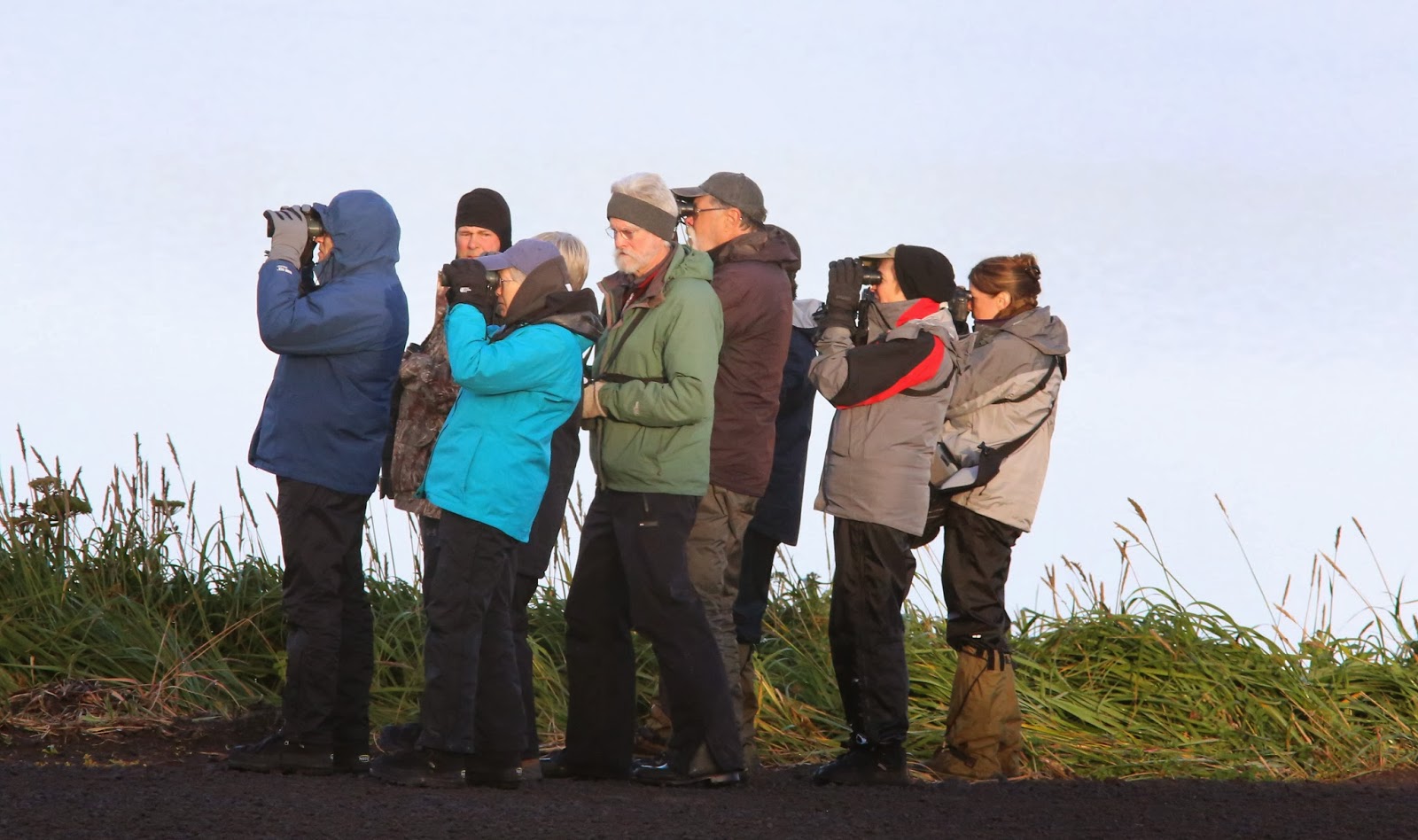
Fifty percent of the participants - Mike Schall (black toque) and Chris Hitt (headband) are most recognizable. 


My room mate was Joe Hanfman, a youngish retiree from a engineering/management position with UPS. Joe was among the sharpest-eyed of us. Nothing with feathers got past Joe. He was also extremely generous and helpful, and shared his case of Coca Cola with me so that I could have a caffeine fix in the evening after birding was over. One can of coke before bed wasn’t going to keep this cowboy awake after a long tramp around the putchkie.

Joe was not just a birder. We shared a common interest in history, particularly the American Civil War and polar exploration. Joe was particularly interested in Ernest Shackleton, the Antarctic explorer, who in Joe’s eyes was a true leader. Joe even visited Shackleton’s grave on the South Shetland Islands.

Across the hall from Joe and me lived Susan Jones, a southern belle from Winston-Salem with a wonderfully quick wit and a slightly ribald sense of humour. Beneath the humour there was a quiet wisdom based upon her full life and widespread travels She too was a warm and generous soul and we liked each other’s company from the get-go. Susan is a director of the ABA, which makes me think that if the other directors are anything like her, I am very glad I am a member of the organization.

Susan’s friend, Lynn Miller, lives in Colorado Springs and volunteers for the ABA once a week. Originally from Georgia, she too was a gentle Southern soul. No one listened to or appreciated us better than Lynn did. In her own special way she was such a nurturing and encouraging presence that I for one know the trip would have been far less enjoyable without her. I have a mental image of her leaning in to the kitchen, thanking the cooks and servers for their efforts in providing us with good food at Trident Seafood. This thoughtful gesture is typical of Lynn, through and through.


Ron Clark of King’s Mountain, NC, was always ready with a joke. He’s a quiet man so I didn’t get to know anything of him until the third or fourth day when I shared a bench on the bus seat with him. He summed up our morning together by saying, “You know you talk to yourself all the time? You mumble. You’re crazy as bat shit, but you’re funny. I would have wanted you as a teacher.” These words won my heart and we spent the rest of the trip joking with each other.

Ann McDowell from New Orleans wasn’t on the ABA tour. She was an independent traveler but, of course, there’s only one bird tour on the island so she joined us and fit right in. Unfortunately for us, she was only with us for about four day before catching the Pen Air flight to St. George Island. It said much about her positive personality that we missed her all the rest of our trip and kept wondering what she was up to on St. George, which is even more isolated than St. Paul.
 
Four couples made up the rest of the crew. Coralee Colter and Paul Prappas were ex-pat Americans, now happily Canadian and living only a few hundred kilometres from me, in Nelson, a haven in southern interior B.C. for artistic and politically active individuals. 

Mike and Corinne Schall were a nice young couple from Bath, PA. Corinne, along with Chris Hitt, was one of our constant volunteers, always willing to help Doug and Scott march around a lake. Corinne of the coppery red hair may have been considerably shorter than her gentlemen stompers but she kept up, never fell behind and became a favourite of us all.

Steve and Debbie Martin of Ozark, MO, were among the quietest of the group, though when they did have something to say, it was always a valuable contribution to the conversation. They told us about the natural distrust of outsiders that some of the people around Ozark displayed toward Deb and Steve, and how there were places not far from their home where it wasn’t wise for an outsider to go, let alone to bird.

Lynn Miller consults with Mike and Corinne Schnell 

Finally there were the two newcomers to birding, Robeck and Mark Faries of Westwood, NJ. Ro, a great extrovert, had befriended everyone on the tour by the second or third day. She’s of Indonesian-Dutch ancestry and has a terrific sense of humour and lots of compassion to go with it. Her husband Mark, movie star handsome with a face made for leading roles in Westerns, was quiet until something took his interest and then the words came out in a rush, his eyes flashed and he emphasized his points with choppy hand movements. Maybe all that hand talk came from his heritage. As he told us, five French brothers came to the Thirteen Colonies and helped in the Revolution by buying a ship for the transport of goods, something the British with their monopoly on naval vessels would have strongly disapproved of. Some of the brothers moved south and eventually Mark’s branch became Texans, wild southern boys who just might have ended up facing one of Joe Hanfman’s ancestors on the battlefields of the Civil War.

Today was a very good day. After a visit to Southwest Point where I saw my lifer Thick-billed Murres flying fast together past the rocky shore, we were driving east toward Pavolina when a very large bird appeared low on the horizon. I was sitting near the front of the bus and happened to see the bird at the same time Scott and Doug spotted it. I watched as Scott shot Doug a look and without a word between them I knew that they had a plan. Doug wheeled the bus left at the intersection, zoomed up the grade as fast as the bus could go and pulled over onto the shoulder while Scott, standing at the folding exit door, ordered us out, out, out. The White-tailed Eagle, an adult with its huge rectangular wings, wide spread pinyons, a short white tail and long head and neck projection, passed before us in good light. Ohs and ahs competed with the rapid fire clicking of cameras as background orchestration for the eagle’s every wingbeat. The only way I can describe the experience is to call it dreamlike. What must we have looked like to the eagle? The blue bus with its humans all lined out along its side, their pale faces skyward, mouths working in wonder at the miracle of this encounter. Gavin had explained to us on our first evening how there was probably just one White-tailed Eagle ranging over several islands and that the bird was seen almost every week, but days usually went by between sightings. There was a very good chance, he said, that we would not see the bird at all, and if we did, we had better look hard because the bird was not known for giving close views.
Slowly the eagle banked to the east and dwindled in our view. That’s when the backslapping, the laughter, the thank yous, the general joy came rushing over us. We had beaten the odds and seen the lone traveler crossing the blue and white skies above St. Paul Island.

From left to right: Chris Hitt, Laura Keene, Doreene Dinzell (turned away), Dan Sanders, Ron Clark, Susan Jones, Robeck Faries (turned away), Steve Martin, Debbie Martin. 
White-tailed Eagle - adult, St. Paul Island, 20 Sept. 2013. Photo by Chris Siddle


After a happy lunch we surveyed Weather Bureau Pond (the usual waterfowl and Red Phalaropes) and headed across the dunes to the northeast passing the snowdrifts of kittiwakes on the bar across Big Lake. I wish now that I had taken a close look to see how closely packed those small gulls were. I got the impression that kittiwakes don’t need much personal space when they loaf or roost or gossip or whatever it was they were doing.

Hutchinson’s Hill was much like it had been yesterday with the nuthatch, the Brambling, and the Red Fox Sparrow still in the notch. Here I got my first look (for the trip) at a Golden-crowned Sparrow which is an uncommon migrant to the island. Other birds that fall into this category of let’s-not- get-too-excited include Sooty Fox Sparrows, and Savannah Sparrows.

Doug Gochfeld and Gavin Bieber lead Joe Hanfman, Paul Prappas, Coralee Colter, Debbie Martin, and Steve Martin around Webster Lake. 


The rest of the day most of us got good looks at Sharp-tailed Sandpipers, and if we were lucky some photos of the juveniles which are attired in rich shades of brown and chestnut. Gavin had us try for the Grey-streaked Flycatcher again. He saw it (from about 10 kms away, such are his Superhero powers), but most of the rest of us didn’t in spite of Doug taking a long uphill walk to try to flush the rarity back toward us.

If you have COMMENTS please send them to chris.siddle@gmail.com

Be sure to check out Laura Keene’s photos at http://flickr.com/gp/keeneone/c6jbV1/